
About this report
About 1,500 people a day use the free UK phone-number checker on this site to find out what kind of number just rang them and which provider Ofcom allocated it to. Each of those checks is a small act of suspicion. Added together, they show which ranges UK phones are seeing unexpected calls from right now, weeks before it shows up anywhere else.
This first edition covers four complete weeks, Monday 24 August to Sunday 20 September 2026. Ofcom's own 2026 research found that 32% of mobile users and 39% of landline users had received a suspicious call in the previous three months (Ofcom, Experiences of suspicious calls, texts and app messages, fieldwork February 2026). This report is a complementary, bottom-up view: not how many people are being called, but which numbers they are being called from.
- Checks in the window
- 14,532
- Distinct visitors
- 12,768
- Mobile share of checks
- 93.2%
- 07 ranges checked
- 537 of 566
- Top 10 ranges' share
- 23.8%
- EE-allocated share of lookups
- 50% (from 27% of ranges)
How to read the numbers
This is a measure of lookup demand: how many people checked a number in a given range. It is not a count of scam calls, and it says nothing about any individual number or the person who holds it. A range can be looked up a lot because a legitimate organisation uses it heavily, because one campaign cycled through it for a week, or because it is simply a large, busy range. We show the range that was checked, the network Ofcom originally allocated it to, and how the count moved week by week. We never show individual numbers.
The ten most-checked UK mobile ranges
| # | Range | Allocated by Ofcom to | Checks | Share of mobile checks | Weekly |
|---|---|---|---|---|---|
| 1 | 07903 | EE | 452 | 3.3% | 27 · 115 · 155 · 155 |
| 2 | 07950 | EE | 392 | 2.9% | 14 · 195 · 109 · 74 |
| 3 | 07415 | EE | 389 | 2.9% | 5 · 117 · 146 · 121 |
| 4 | 07300 | EE | 381 | 2.8% | 60 · 148 · 98 · 75 |
| 5 | 07432 | EE | 361 | 2.7% | 14 · 76 · 104 · 167 |
| 6 | 07498 | EE | 321 | 2.4% | 42 · 125 · 87 · 67 |
| 7 | 07534 | EE | 308 | 2.3% | 20 · 130 · 121 · 37 |
| 8 | 07423 | Vodafone | 243 | 1.8% | 118 · 83 · 4 · 38 |
| 9 | 07963 | EE | 190 | 1.4% | 6 · 48 · 52 · 84 |
| 10 | 07956 | EE | 183 | 1.4% | 9 · 50 · 60 · 64 |
Weekly = checks in each of the four weeks ending 30 Aug, 6 Sep, 13 Sep, 20 Sep. Share is of all 13,546 UK mobile checks in the window.
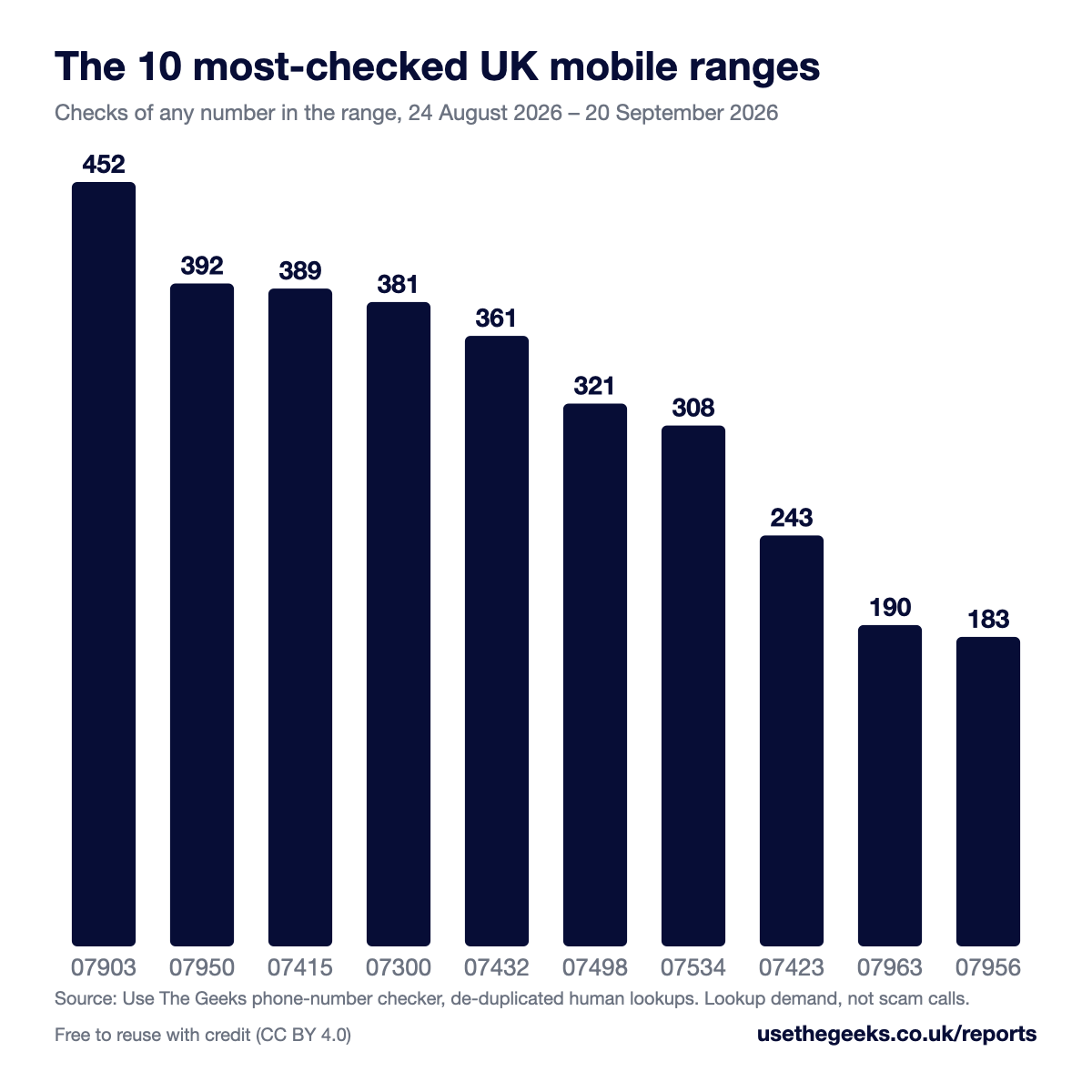
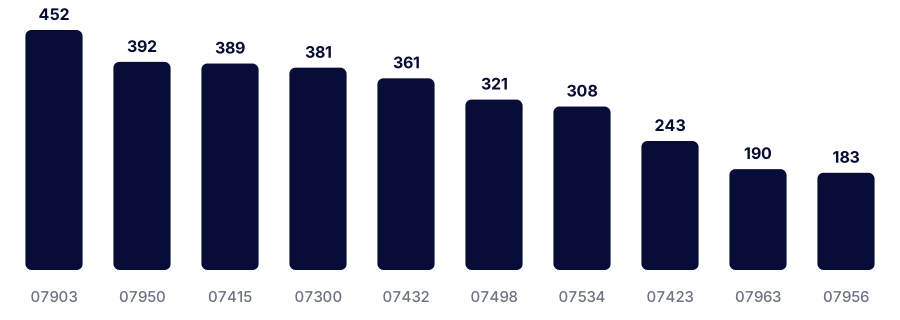
Together these ten ranges were 23.8% of the 13,546 mobile checks in the window. Each range has its own page on this site with the full Ofcom holder table, allocation status and a chart of weekly checks, refreshed every week; the whole set is in the number-range directory.
Where suspicion lands, by network
| Network (original allocatee) | Share of mobile lookups | Share of allocated 07 blocks | Lookups relative to size |
|---|---|---|---|
| EE | 50.0% | 27.5% | 1.8× |
| O2 | 23.4% | 28.4% | 0.8× |
| Vodafone | 12.1% | 21.0% | 0.6× |
| Three | 11.0% | 17.0% | 0.6× |
| All others | 3.4% | 6.2% | 0.5× |
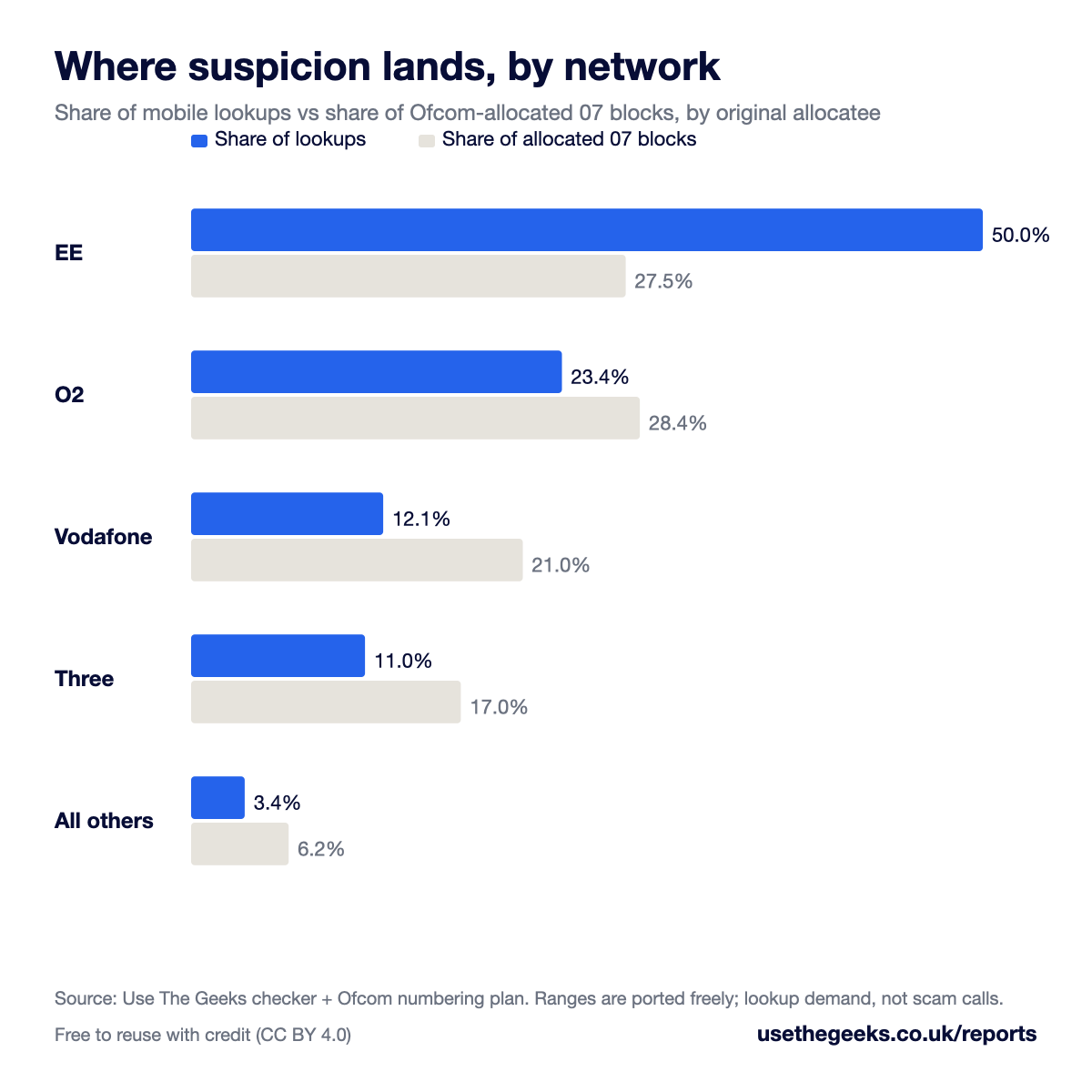
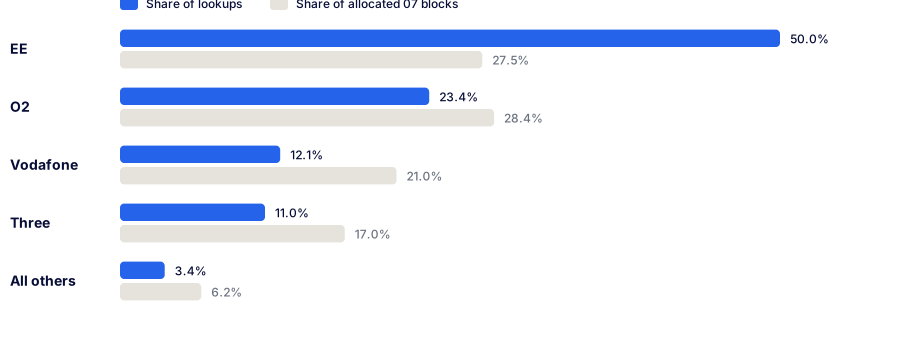
Ranges originally allocated to EE (including the legacy Orange ranges) attracted 50% of all mobile lookups, yet make up 27% of the allocated 07 numbering space. O2 ranges were 23% of lookups from 28% of the space; Vodafone 12% from 21%; Three 11% from 17%.
We do not know why, and the data cannot tell us. UK mobile numbers are ported freely, so the network a range started on is not necessarily the network the caller is on today, and EE is the largest UK mobile network by customers, so some of the gap is simply scale. What we can say is that if you get an unexpected call from a 079xx or 074xx number, you are in good company.
Bursts, not blacklists
Rising fastest
Ranges with at least 30 checks in the relevant week, ranked by the size of the change.
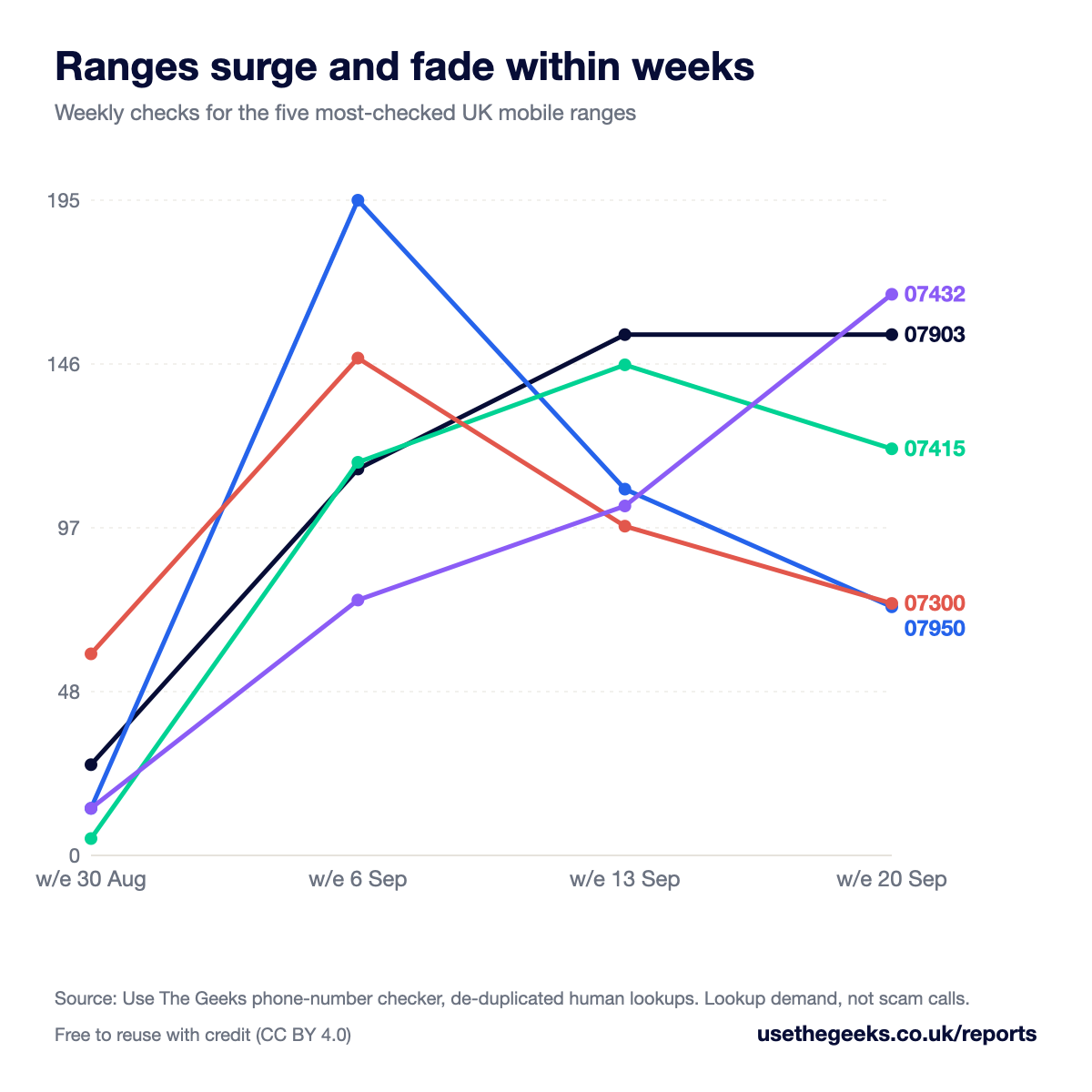
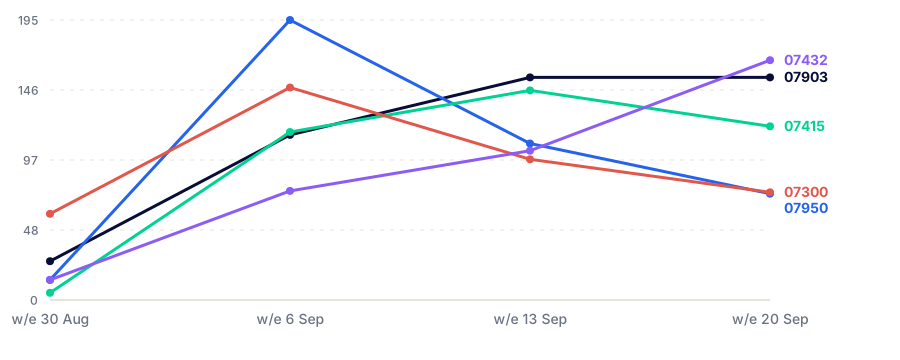
07495 went from 2 checks in the week ending 13 September to 114 the following week. 07722 rose from 30 to 97 and 07375 from 42 to 104. In the other direction, 07534, seventh overall, fell from 121 to 37, and 07423 spiked at 118 in late August before collapsing to 4. This is what a campaign looks like: a block of numbers is used hard for a week or two, then abandoned. It is why we publish weekly charts rather than a fixed list, and why no range should be treated as permanently good or bad.
Repeat numbers. Of 11,092 distinct mobile numbers checked, 108 were each looked up by five or more different people, and the single most-checked number was looked up by 62 different people in four weeks. We do not publish those numbers, but the concentration shows a small set of numbers being dialled at scale.
Non-geographic numbers: was it really the NHS?
| Range | Checks | Share of 03/08/09 checks |
|---|---|---|
| 0300 | 157 | 33% |
| 0330 | 49 | 10% |
| 0331 | 33 | 7% |
| 0333 | 33 | 7% |
| 0344 | 21 | 4% |
| 0345 | 20 | 4% |
| 0353 | 18 | 4% |
| 0800 | 14 | 3% |
| 0808 | 9 | 2% |
| 0845 | 5 | 1% |
There were 472 lookups of 03, 08 and 09 ranges. A third of them, 157, were 0300 numbers, ahead of 0330 (49), 0331 (33) and 0333 (33). 0300 is reserved for public bodies and charities, and it is exactly the range fraudsters imitate when posing as the NHS, HMRC or a council. Freephone 0800 and 0808 together drew only 23 checks. Premium-rate 09 numbers drew 54, of which 24 were 0909, the classic "missed call, ring us back" bait.
Landlines: London, then Manchester
| Area (dialling code) | Checks | Share of landline checks |
|---|---|---|
| London 020 | 157 | 31% |
| Manchester 0161 | 27 | 5% |
| Cardiff 029 | 14 | 3% |
| Northern Ireland 028 | 13 | 3% |
| Birmingham 0121 | 12 | 2% |
| Liverpool 0151 | 12 | 2% |
| Leicester 0116 | 11 | 2% |
| Leeds 0113 | 10 | 2% |
Landline ranges were only 3.5% of lookups, 514 checks, but 30% of those were London 020 numbers, and 020 3 alone accounted for 78. Manchester 0161 followed, then Cardiff 029, Belfast 028 and Birmingham 0121. Since 29 January 2025, UK providers have been required by Ofcom to block calls from abroad that falsely present a UK landline number, so a spoofed London number now has to be generated closer to home.
Foreign and 070 numbers: rarer than the warnings suggest
Only 14 lookups in the window were of foreign numbers, six of them Irish (+353), and only 21 were 070 "personal" numbers. Both feature heavily in scam advice; both are, on this evidence, a small part of what UK phones actually see. The biggest remaining spoofing loophole, calls from abroad presenting a +44 7 mobile number, is being closed: under Ofcom guidance published on 15 July 2026, providers must withhold the caller ID on such calls from 15 July 2027 unless they can verify the caller is genuinely roaming.
When people check
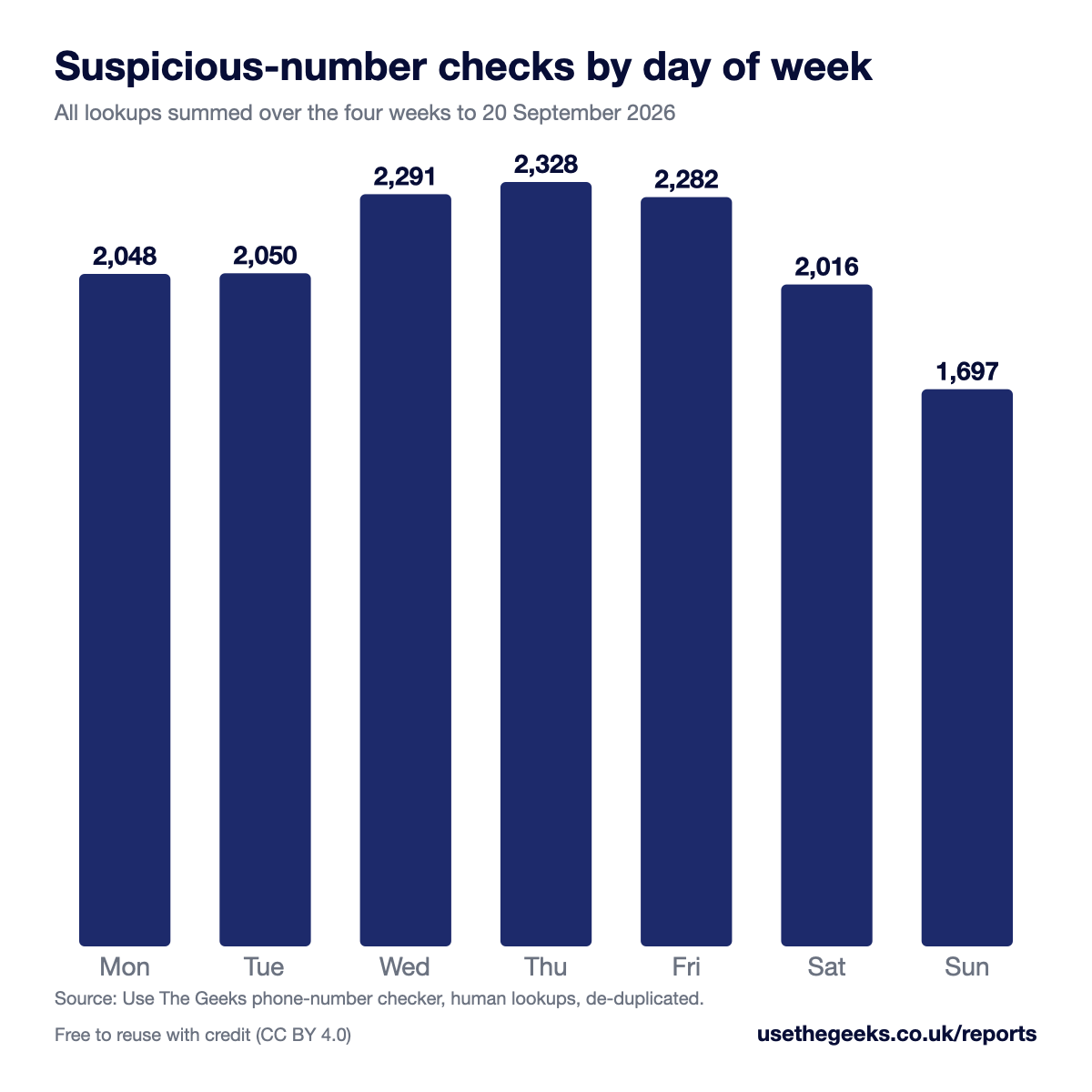
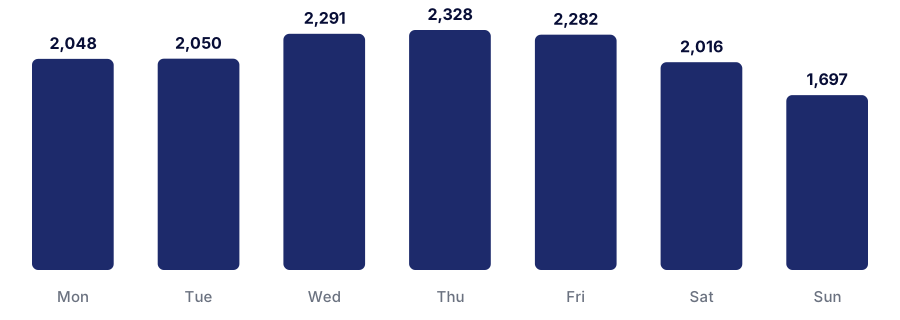
Thursday was the busiest day for lookups and Sunday the quietest, 27% lower. Wednesday to Friday were the three busiest days. Nuisance calling, like the call centres that make it, keeps office hours.
"Every one of these 14,500 checks is somebody who didn't trust the number on their screen. Put them together and you get a live map of which ranges are being used to bother people this month, not last year." — Andrew Pickett, CEO, Use The Geeks
If one of these ranges calls you
- Do not ring back a number that rang once and hung up, especially an 09 or foreign number.
- Check the number free: you will see the range type and who Ofcom allocated it to, which is enough to spot a "bank" calling from a mobile.
- Never give a caller a one-time code, PIN or password. Hang up and ring the organisation on a number from its website or your card.
- Forward scam texts to 7726, free, so your network can act.
- Report fraud to Action Fraud on 0300 123 2040 or actionfraud.police.uk (Police Scotland: 101). Our guide to reporting a scam number walks through each route.
Method
Source: the free UK phone-number checker at usethegeeks.co.uk. Counts are human visitors only (automated traffic is excluded); one check is one person checking one number on one day, so somebody re-checking the same number counts once; Ofcom's TV-drama and example ranges are excluded because our own pages use them as live demonstrations. The window is four complete ISO weeks, Monday 24 August to Sunday 20 September 2026: 14,712 lookups, 14,532 of them attributable to a UK number range, from 12,768 distinct visitors.
Network attribution is the range holder in Ofcom's weekly numbering plan as of 16 September 2026, and refers to the range, not the individual number. "Share of allocated 07 blocks" counts Ofcom-allocated 10,000-number blocks in the 07 mobile range (excluding 070 personal and 076 paging). The same per-range figures update weekly on every range page. Quote freely with a link to this page.
Download the data
- Top 25 mobile ranges (CSV) — rank, range, Ofcom allocatee, checks, share, weekly counts
- Full dataset (JSON) — every range with weekly counts, number-type mix, day-of-week, method fields
- The 10 most-checked UK mobile ranges (PNG, 1200×1200) — press-ready chart card
- Share of lookups vs share of numbering space, by network (PNG, 1200×1200) — press-ready chart card
- Checks by day of week (PNG, 1200×1200) — press-ready chart card
- Weekly checks for the top five ranges (PNG, 1200×1200) — press-ready chart card
Free to reuse under CC BY 4.0: quote or republish any figure, table or chart with a credit to Use The Geeks and a link to this page. Licence: CC BY 4.0.
Press contact
Andrew Pickett, CEO & Founder, Use The Geeks
info@usethegeeks.co.uk · 0333 006 9399
Available for interview and for regional or sector cuts of the data. Please credit Use The Geeks and link to this page.
About Use The Geeks
Use The Geeks is a Burnley-based managed IT and telecoms provider supporting businesses across Lancashire and the UK with IT support, cloud telephony, connectivity and business mobile. Its free UK phone-number checker, built on Ofcom's public numbering data, is used around 1,500 times a day and identifies the range and provider of any UK number, never the individual holding it.
Frequently asked questions
Does this mean EE numbers are more likely to be scam calls?
No. The data shows which ranges people looked up, and ranges originally allocated to EE were looked up roughly twice as often as their share of the numbering space. EE is also the UK's largest mobile network, UK numbers are ported between networks freely, and the network a range started on says nothing about who is using a particular number today. Treat it as a description of where suspicion lands, not a verdict on any network.
Is 07903 (or any range in the list) a scam number?
No range is a scam number. 07903 is an ordinary UK mobile range with tens of thousands of legitimate users; it simply received the most lookups in this window. Ranges rise and fall within weeks as campaigns move on, which is why we publish weekly charts rather than a fixed list.
Can I get the individual numbers?
No. We never publish, share or sell individual numbers, and the checker does not identify the person or business behind a number. The report and the downloadable data contain range-level counts only.
How often is the data updated?
The per-range figures on each number-range page refresh every week. This report is published quarterly with a frozen snapshot of its window so that any figure quoted from it stays verifiable.
Can I reuse the charts and tables?
Yes. Everything on this page is published under a Creative Commons Attribution 4.0 licence. Quote or republish any figure, table or chart with a credit to Use The Geeks and a link to this page. The downloads section has each chart as a 1200 by 1200 PNG, the top-25 table as CSV and the full dataset as JSON.